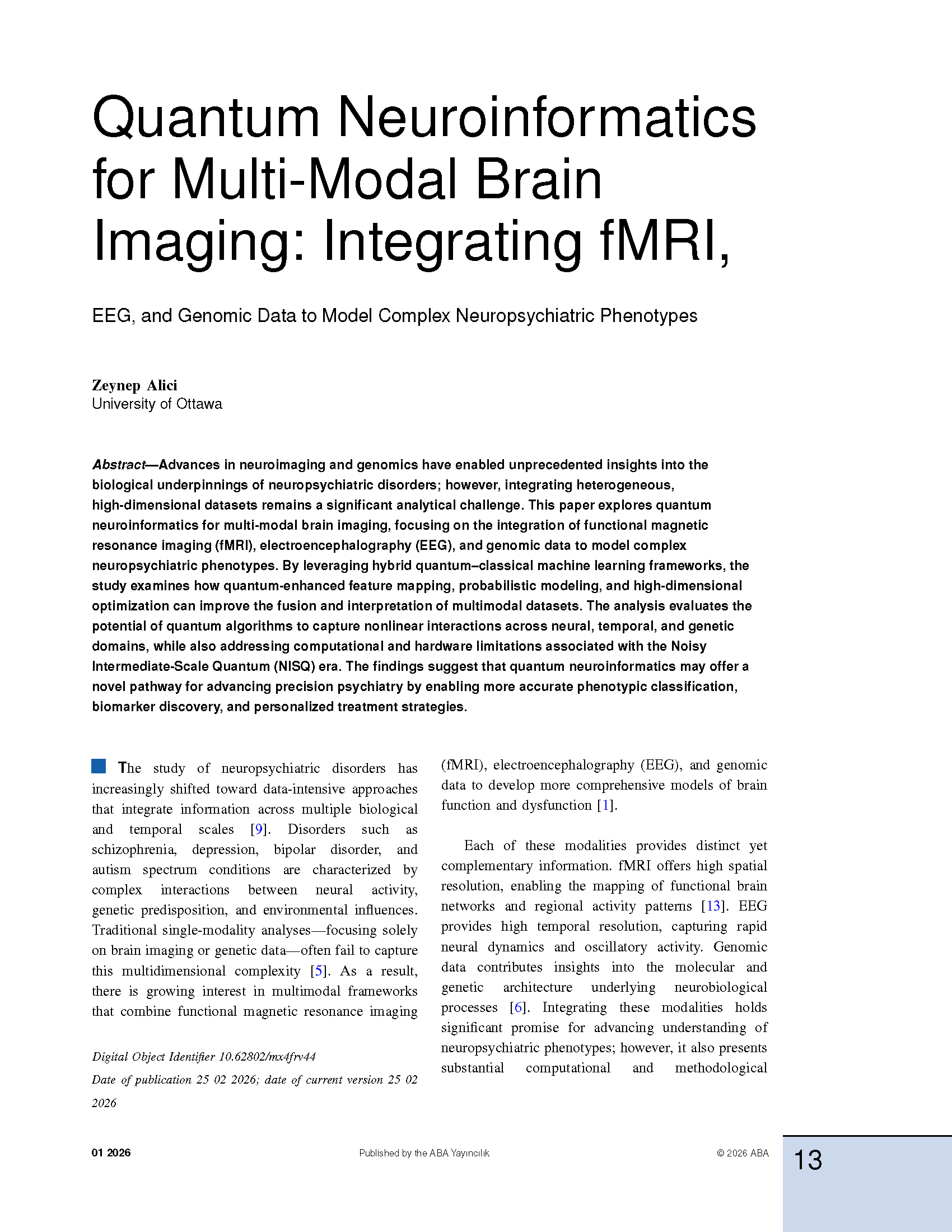
Quantum Neuroinformatics for Multi-Modal Brain Imaging: Integrating fMRI, EEG, and Genomic Data to Model Complex Neuropsychiatric Phenotypes
DOI:
https://doi.org/10.62802/mx4frv44Keywords:
quantum neuroinformatics, fMRI, EEG, genomics, neuropsychiatric disorders, multimodal data integration, precision medicineAbstract
Advances in neuroimaging and genomics have enabled unprecedented insights into the biological underpinnings of neuropsychiatric disorders; however, integrating heterogeneous, high-dimensional datasets remains a significant analytical challenge. This paper explores quantum neuroinformatics for multi-modal brain imaging, focusing on the integration of functional magnetic resonance imaging (fMRI), electroencephalography (EEG), and genomic data to model complex neuropsychiatric phenotypes. By leveraging hybrid quantum–classical machine learning frameworks, the study examines how quantum-enhanced feature mapping, probabilistic modeling, and high-dimensional optimization can improve the fusion and interpretation of multimodal datasets. The analysis evaluates the potential of quantum algorithms to capture nonlinear interactions across neural, temporal, and genetic domains, while also addressing computational and hardware limitations associated with the Noisy Intermediate-Scale Quantum (NISQ) era. The findings suggest that quantum neuroinformatics may offer a novel pathway for advancing precision psychiatry by enabling more accurate phenotypic classification, biomarker discovery, and personalized treatment strategies.
References
Baghdadi, G., Hadaeghi, F., & Kamarajan, C. (2025). Multimodal approaches to investigating neural dynamics in cognition and related clinical conditions: integrating EEG, MEG, and fMRI data. Frontiers in Systems Neuroscience, 19, 1495018.
Columbus Chinnappan, C., Thanaraj Krishnan, P., Elamaran, E., Arul, R., & Sunil Kumar, T. (2025). Quantum computing: foundations, architecture and applications. Engineering Reports, 7(8), e70337.
Comai, S., Manchia, M., Bosia, M., Miola, A., Poletti, S., Benedetti, F., ... & Serretti, A. (2025). Moving toward precision and personalized treatment strategies in psychiatry. International Journal of Neuropsychopharmacology, 28(5), pyaf025.
Keçeci, M. (2025). Understanding quantum mechanics through hilbert spaces: Applications in quantum computing. Preprint.
Li, G., & Lock, E. F. (2025). Integrative Analysis of Multimodal Omics Data. Annual Review of Statistics and Its Application, 13.
Malhotra, E. A. R. A., & Jiménez, S. (2025). Neurogenetics and Genomics: Exploring the Genetic Architecture of Brain Function and Neurological Disorders: A Neurobiological Perspective. J. Neuroscience Innovations and Disorders, 1(1), 0003.
Nooraiepour, M. (2025). Traditional and machine learning approaches to partial differential equations: A critical review of methods, trade-offs, and integration. Preprints (Sept. 2025). Doi, 10, 20944.
Prajapati, B., & Prajapati, R. (2026). Quantum Machine Learning: A Review of Hybrid Classical-Quantum Approaches. Quanta, 15, 1-12.
Ramdas, G. V., & Sahana, D. (2026). Cognitive Computing and Neurobiology: A New Era in Brain Health. Artificial Intelligence and Machine Learning in Neurology, 2, 763-783.
Shamim, M., Faridi, A. R., & Masood, F. (2025, April). Analysis of Emerging Trends and Challenges in Multimodal Data. In 2025 12th International Conference on Computing for Sustainable Global Development (INDIACom) (pp. 1-7). IEEE.
Sihare, S. R. (2025). Dimensionality reduction for data analysis with quantum feature learning. Wiley Interdisciplinary Reviews: Data Mining and Knowledge Discovery, 15(1), e1568.
Wani, A. A. (2025). Comprehensive review of dimensionality reduction algorithms: challenges, limitations, and innovative solutions. PeerJ Computer Science, 11, e3025.
Zhao, L. (2025). Advances in functional magnetic resonance imaging-based brain function mapping: a deep learning perspective. Psychoradiology, 5, kkaf007.
Downloads
Published
Issue
Section
How to Cite